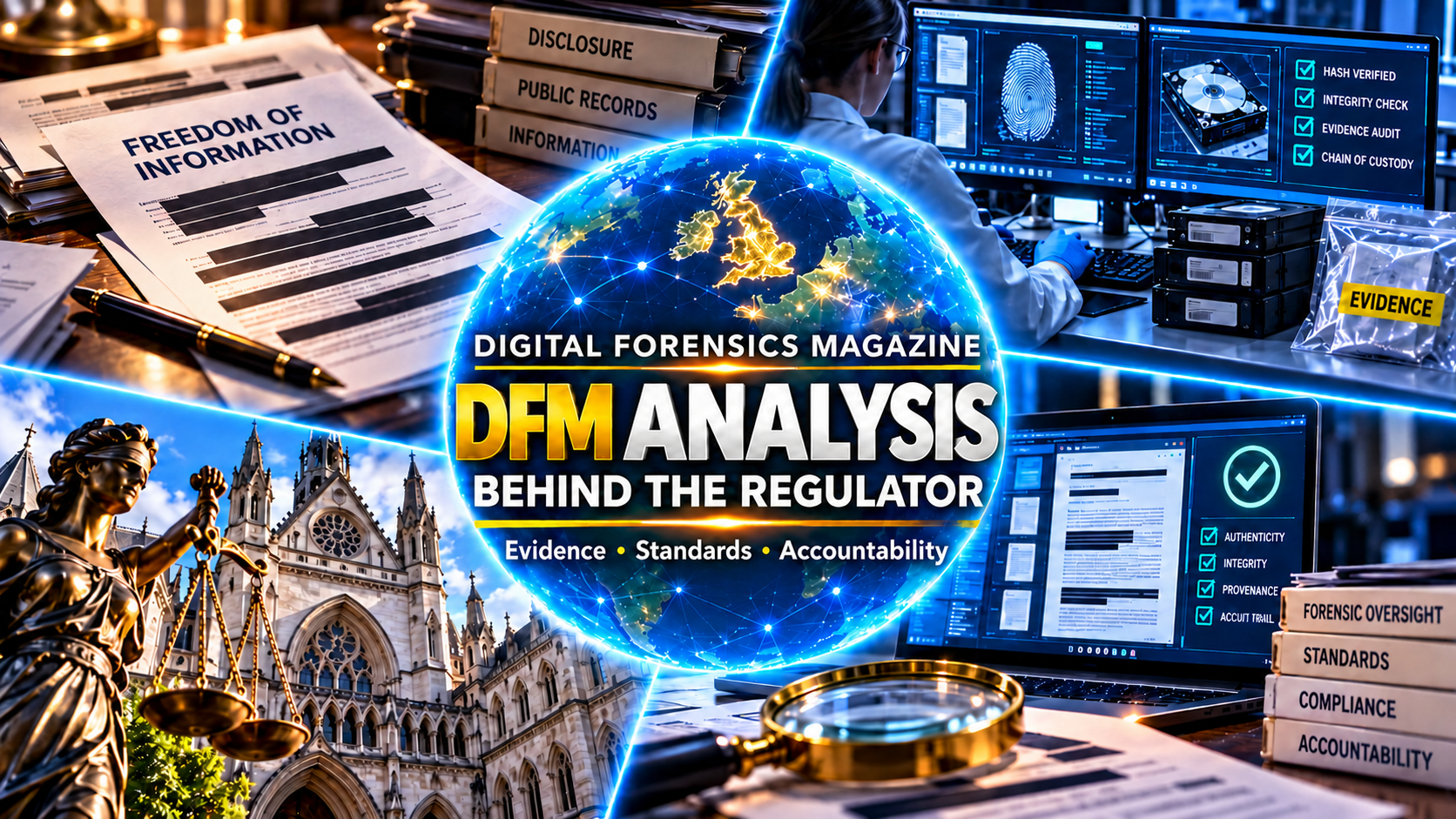

Behind the Regulator: What 25 FOI Disclosures Reveal About UK Forensic Oversight
A newly published archive of historical responses sheds light on how forensic failures are reported, when statutory powers are used, and the challenges of overseeing digital evidence.
The UK Forensic Science Regulator published 25 redacted Freedom of Information responses on GOV.UK between 19 and 23 October 2026. The batch may look like an administrative update, but several answers offer a useful window into the accountability mechanisms behind forensic science in England and Wales.
There is an essential qualification: the responses are historical. Most were written in 2023 or 2024. Their appearance on GOV.UK in October 2026 does not mean the events and figures are new, or that the position described remains unchanged today.
Even so, viewed alongside more recent published specialist-group minutes, they present a question of continuing relevance to digital forensic practitioners: how do reported problems translate into corrective action, transparent oversight and demonstrable confidence in evidence?
What happens to a reported forensic failure?
One of the most revealing responses, FOI-0024, was dated 6 June 2024. It recorded 200 self-referrals and 47 third-party referrals across the stated periods from 11 May 2022 to 30 May 2024.
The distinction matters. A self-referral arises within a forensic unit's own management and reporting process. A third-party referral may come from an accreditation body, another provider, a whistleblower, a member of the public, or an organisation concerned about a potential miscarriage of justice. These are reported non-conformances or concerns, not necessarily 247 established breaches or miscarriages of justice.
The figures were:
| Reporting period | Self-referrals | Third-party referrals |
|---|---|---|
| 11 May–24 July 2022 | 9 | 6 |
| 25 July 2022–24 July 2023 | 91 | 23 |
| 25 July 2023–30 May 2024 | 100 | 18 |
| Total | 200 | 47 |
The Regulator also stated that, as of that June 2024 response, it had not exercised its investigation powers under Section 5 of the Forensic Science Regulator Act 2021 since they came into force.
That should not be confused with a claim that referrals went unexamined. The response explains that referrals are assessed on receipt. A statutory Section 5 investigation is a specific power, subject to a substantial-risk threshold; other forms of assessment and resolution may be appropriate. Nevertheless, it would be valuable to know more about outcomes: how many cases resulted in remedial action, changes in practice, further monitoring or escalation?
Another response, FOI-0023, reported zero formal complaints about the Regulator's own service or conduct. Those complaints are defined differently from referrals about non-conforming forensic activity. Reporting the two numbers without distinguishing them would create a misleading picture.
For digital forensics, the underlying issues are familiar. Problems with tool validation, examination procedures, interpretation and disclosure can propagate from technical processes into investigative decisions. A transparent system should make it possible to understand not merely how concerns enter the regulatory process, but what is learned from them.
Digital standards: who is responsible for implementation?
FOI-0018, dated October 2023, concerned officers' recovery and processing of CCTV footage. The Regulator stated that it had issued no directions to the National Police Chiefs' Council about how officers should achieve compliance and held no email correspondence with the NPCC specifically about the training required for CCTV recovery.
The explanation was one of responsibility: the Regulator develops the statutory Code of Practice and sets quality standards, while organisations carrying out forensic science activities decide how to meet them. The Code identifies recovery and processing of CCTV and video surveillance material as a regulated digital forensic activity.
This is a legitimate division of roles, but it invites scrutiny of how practice is made consistent across forces, providers and frontline personnel, particularly where specialists are not the first people to handle the material.
The Digital Forensics Specialist Group has resumed work
One of the older FOI responses, FOI-0017, said that minutes from a 3 November 2022 Digital Forensics Specialist Group meeting had not been approved because there had been no subsequent meeting by September 2023. Taken alone, that might suggest prolonged inactivity.
The more recent record changes the picture. The Regulator's 2023–24 annual report said the group was expected to be re-formed in the following reporting year, and GOV.UK now publishes minutes for 8 July 2025, 2 February 2026 and 15 May 2026.
Those meetings demonstrate renewed activity and identify substantive issues for the profession. The February 2026 minutes discuss the practical implementation of the Code, risks associated with rapidly changing and sometimes inadequately validated technologies, and the use of AI-enabled review and transcription tools. They also record concern about communication pathways between the specialist group, the DIG 100 subgroup, NPCC working groups and other digital forensic bodies. Members wanted to avoid duplicated work and gaps in escalation.
The discussions point towards a regulatory challenge broader than any single FOI response: how to maintain meaningful assurance when tools, investigative workflows and digital evidence sources evolve faster than traditional validation and accreditation cycles.
Accountability is About Outcomes
None of the historical FOI answers establishes systemic failure. Nor does the absence of a Section 5 investigation, on its own, prove that the Regulator has been inactive or ineffective. The latest specialist-group records, in fact, document active work on important digital forensic questions.
What the material does show is why outcome-focused transparency matters. Counts of referrals are informative, but practitioners, courts and the public also need confidence that significant risks are recognised, managed and, where appropriate, escalated. Similarly, publishing standards is only part of the task; implementation, training, validation and consistent operational assurance determine whether those standards protect the evidence that reaches court.
The October 2026 publication of this FOI archive is therefore an opportunity to ask the Regulator for updated referral outcomes, an account of how its statutory powers are considered, and the next steps from the Digital Forensics Specialist Group's current programme.
The question for the profession is not simply how many forensic problems are reported. It is how effectively the system learns from them.
Make DFM part of your professional reading
Explore the magazine, Briefing Centre and full issue archive. See the available subscription options and choose the access that suits you.
Explore DFM subscriptionsExplore the Briefing CentrePrimary sources
- FSR FOI-0024 — referrals and Section 5 investigations (response dated 6 June 2024)
- FSR FOI-0023 — definition and figures for formal complaints (response dated 10 May 2024)
- FSR FOI-0018 — CCTV recovery, training and NPCC responsibilities (2023)
- FSR FOI-0017 — historical Digital Forensics Specialist Group minutes (2023)
- FSR membership page — Digital Forensics Specialist Group minutes for 2025–26
- Digital Forensics Specialist Group minutes — 2 February 2026
- FSR annual report 2023–24
Advertisements


Latest Issue

Student Discount

Briefing Centre



Advertise With DFM