Back Issues

Back Issue 54
 admin
11/07/2024
admin
11/07/2024
Issue 54 analyses practitioner challenges in APT investigations across large commercial networks, the contemporary relevance of historical intelligence dilemmas, and operational compliance demands in regulated forensic environments. Additional features examine professionalisation within the security-testing sector and explore nuclear-sector cybersecurity leadership, highlighting governance, assurance, and investigative-readiness considerations essential to complex organisational, regulatory and adversarial contexts.


Back Issue 53
admin
18/09/2023
Issue 53 examines applied and conceptual dimensions of artificial intelligence within security and justice contexts, including multimodal algorithmic strategies for access control and AI’s emerging role across criminal-justice processes. Further features explore AI’s origins, analyse the global ramifications of the WannaCry attack, and review the Cyber Scheme’s evolution in addressing skills development and professional capability within the UK cybersecurity ecosystem.

Back Issue 52
admin
18/09/2023
Challenges Detecting Email Scams – Natural Language Processing
The use of email has evolved radically since the 1960s when the first email was sent. It was simple text and sent between a limited number of mainframe computers in the network. Today emails are multimedia, have their own servers or cloud service, and are at the core of global communications.
Rethinking Remote DFIR – Why Investigators Need to Remotely Access Devices Online in The New Normal
Effective data management practices are no longer a, nice to have. Today, they are fundamental to the success of almost every business department. In a recent DFIR report, half of the 56 organisations surveyed revealed that their workforce was more than 50% remote, while close to a third had a workforce who were 75% remote.
Forensic Analysis of the NetWire Stack – A project related to NetWire stack analysis
NetWire was used in one of the highest-stakes cases to conduct long-term surveillance and surreptitiously deliver incriminating documents which were later used in criminal prosecution. Casework at Arsenal has involved the analysis of computers compromised by versions of the NetWire remote access trojan (RAT).
Empowering Digital Forensics in Policing – Why Law Enforcement Agencies Must Transition to Intelligent Cloud Review Platforms
Jon Cook from Exterro investigates why Law Enforcement Agencies Must Transition to Intelligent Cloud Review Platforms and how digital forensics professionals can leverage key technologies to make the most out of data in criminal investigations.

Back Issue 51
admin
18/09/2023
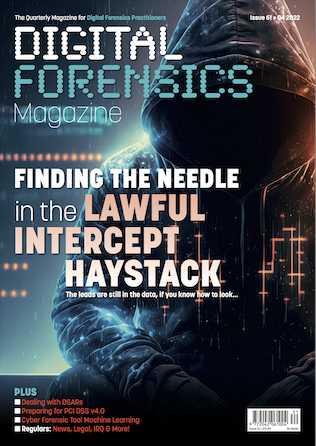
Issue 51 evaluates machine-learning approaches for cyber-forensic tool automation, examining performance, reliability and operational risk. Additional features address deriving investigative leads from lawful-intercept datasets, organisational responses to DSAR-driven workloads, and preparations for PCI DSS v4.0. Collectively, the issue highlights methodological, regulatory and evidential considerations shaping contemporary forensic practice and secure data-handling requirements across diverse investigative environments.