Back Issues

Back Issue 22
 admin
01/02/2015
admin
01/02/2015
Issue 22 examines advanced SQLite-evidence extraction, smartphone-investigation models for cloud-centric environments, and emerging forensic methodologies for IoT incidents. Additional features explore big-data analytics for intelligence, characteristics of the deep web, SME cybersecurity challenges, and evolving IoT botnet threats. Articles on public-sector data-handling, PCI DSS compliance, African cyber-law reforms, and network-security big-data monitoring highlight diverse operational and governance considerations.

Back Issue 21
admin
01/11/2014
Issue 21 examines foundational and emerging challenges across digital forensics, including SQLite-based artefact reconstruction, large-scale image-recovery analytics, memory-resident cryptographic key extraction, and security concerns within cyber-physical systems. Additional research addresses IPv6 tunnelling vulnerabilities, security-analytics evolution, email-security modernisation, APT-resilience strategies, and narrative framing for cyber-physical adoption, with legal and laboratory features expanding practice-ready investigative and evidential methodologies.

Back Issue 20
admin
01/08/2014
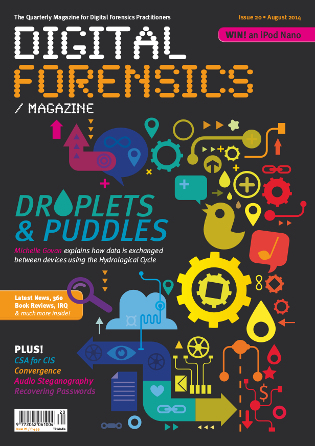
Issue 20 examines volatile-memory credential recovery, steganography detection in audio streams, and cross-device data exchange through hydrological-cycle analogies. Features explore convergence between IT security and physical access control, governance of privileged permissions, and psychological influences on user behaviour. Articles further address critical-infrastructure security attributes, ZFS-based super-timelines, and the emergence of the Cyber Scheme, alongside legal and laboratory insights into mobile-device investigations.

Back Issue 19
admin
01/05/2014
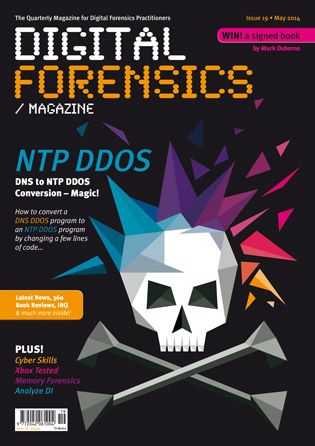
Issue 19 spans core cyber-skills development, emerging attack vectors, and platform-specific vulnerabilities, while advancing practice-ready methodologies for volatile-memory credential recovery, mobile-device investigation, and wearable-technology forensics. Themes include human-factor security, automation for capability uplift, watermarking for intellectual-property protection, and maturing incident-response functions. Legal and laboratory features analyse EU cyber-crime initiatives and evolving investigative tooling across increasingly multimedia-rich evidential environments.

Back Issue 18
admin
01/02/2014
Issue 18 explores practitioner-focused advances in malware correlation using fuzzy hashing, DFIR temporal reasoning through Anchors in Relative Time, and Android security weaknesses relevant to exploitation and investigation. It examines GPS accuracy implications for evidential reliability, organisational forensic-readiness planning, and analytics-driven fraud prevention. The issue also highlights evolving cyber-skills requirements and lab perspectives on mobile-forensics tool integration.