
DFM Analysis / New WCIT Briefing Paper
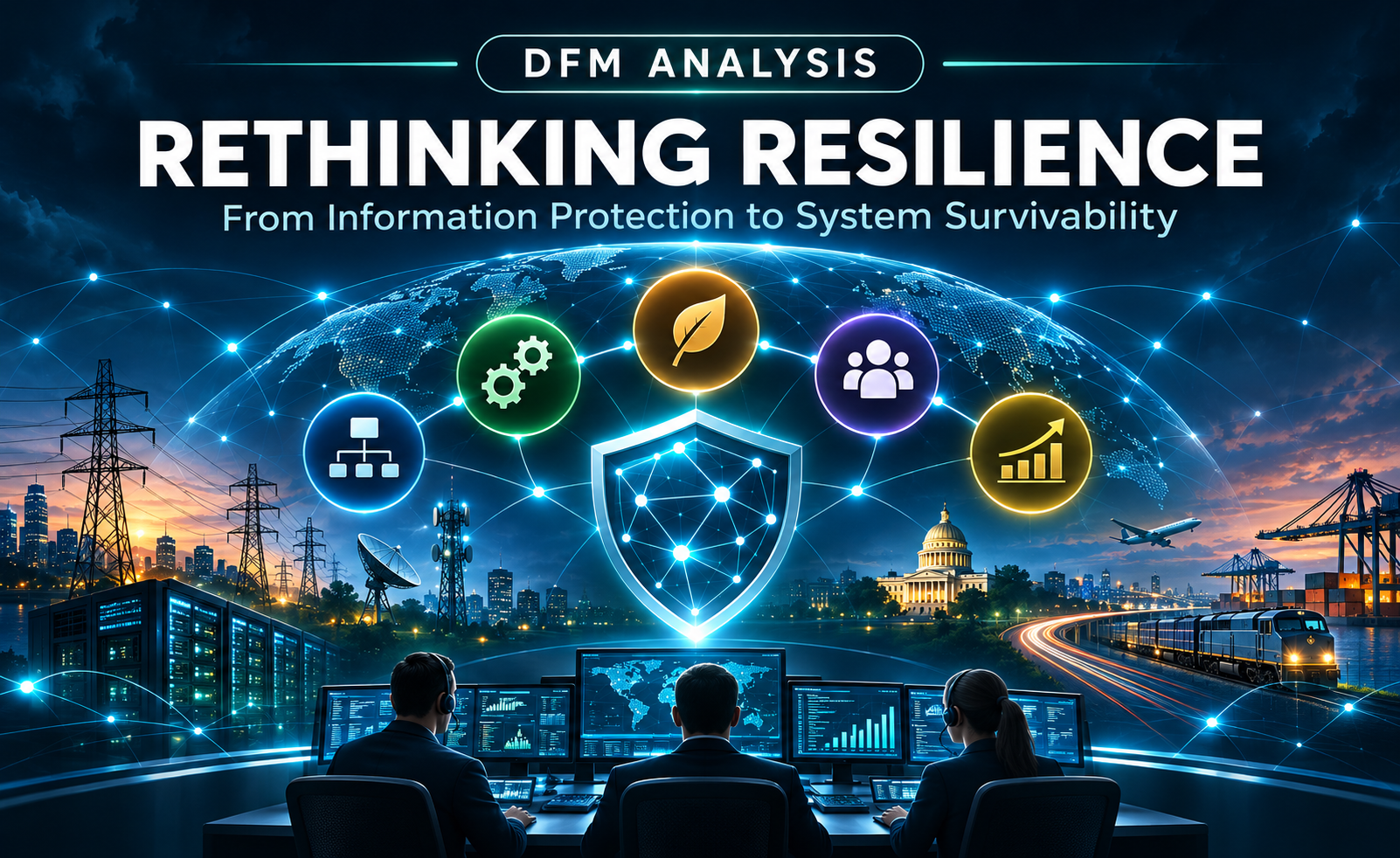
Rethinking Resilience: Are We Protecting Information or Ensuring Survivability?
Modern society depends on increasingly connected, automated and interdependent systems. Yet when disruption strikes, the consequences rarely remain confined to where they began. Are our approaches to resilience keeping pace with the world we have created?
A new briefing paper, Rethinking Resilience in an Autonomous and Interconnected World: From Information Protection to System Survivability, published under the aegis of the Worshipful Company of Information Technologists (WCIT) Security Panel, challenges some familiar assumptions about how we prepare for disruption.
“Resilience without redundancy is efficiency, not survivability.”Central proposition of the WCIT briefing paper
Resilience is bigger than cyber security
Cyber security is indispensable, particularly wherever digital systems control physical processes. But it cannot, on its own, guarantee the continuity of essential services. Power interruption, mechanical failure, supply chain breakdown or an error in automated decision-making can produce consequences as serious as a cyber-attack.
The paper widens the lens from protecting information and individual technologies to the continued delivery of critical functions across interacting technical, physical, operational and human environments.
Five domains, one survivability problem
Architecture, operations, physical conditions, human decisions and economic incentives all influence how a system withstands disruption. Weakness in any one domain can undermine the others.
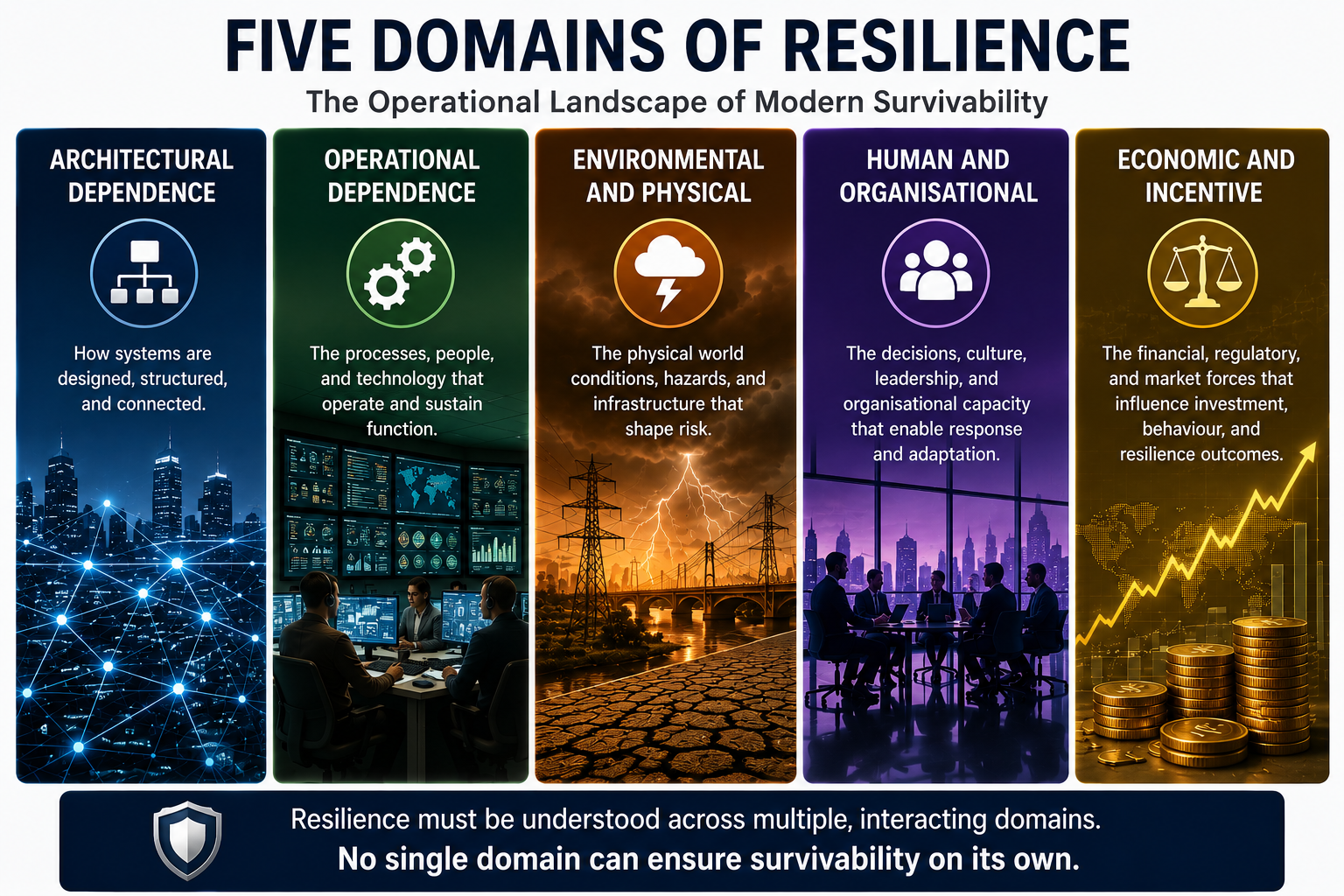
Consider how those domains interact in practice. Architectural choices determine where capabilities are concentrated, which services share common dependencies and where alternative pathways might exist. Operational arrangements determine whether those capabilities can actually be sustained when normal conditions deteriorate.
Environmental and physical conditions introduce another dimension: severe weather, infrastructure damage and equipment failure do not respect organisational boundaries. Meanwhile, human judgement, leadership and preparedness influence how quickly disruption is recognised, decisions are made and available resources are redirected.
The fifth domain, economics and incentives, is particularly challenging. The benefits of spare capacity and fallback arrangements may be difficult to demonstrate during uninterrupted operation, while the costs of maintaining them are immediate and visible. Decisions that appear rational within an individual budget may therefore create vulnerabilities elsewhere in the wider system.
Taken together, these domains invite a different kind of resilience assessment: not merely whether each component is protected, but whether the relationships between components will allow essential functions to continue when circumstances change.
When one failure becomes everyone’s problem
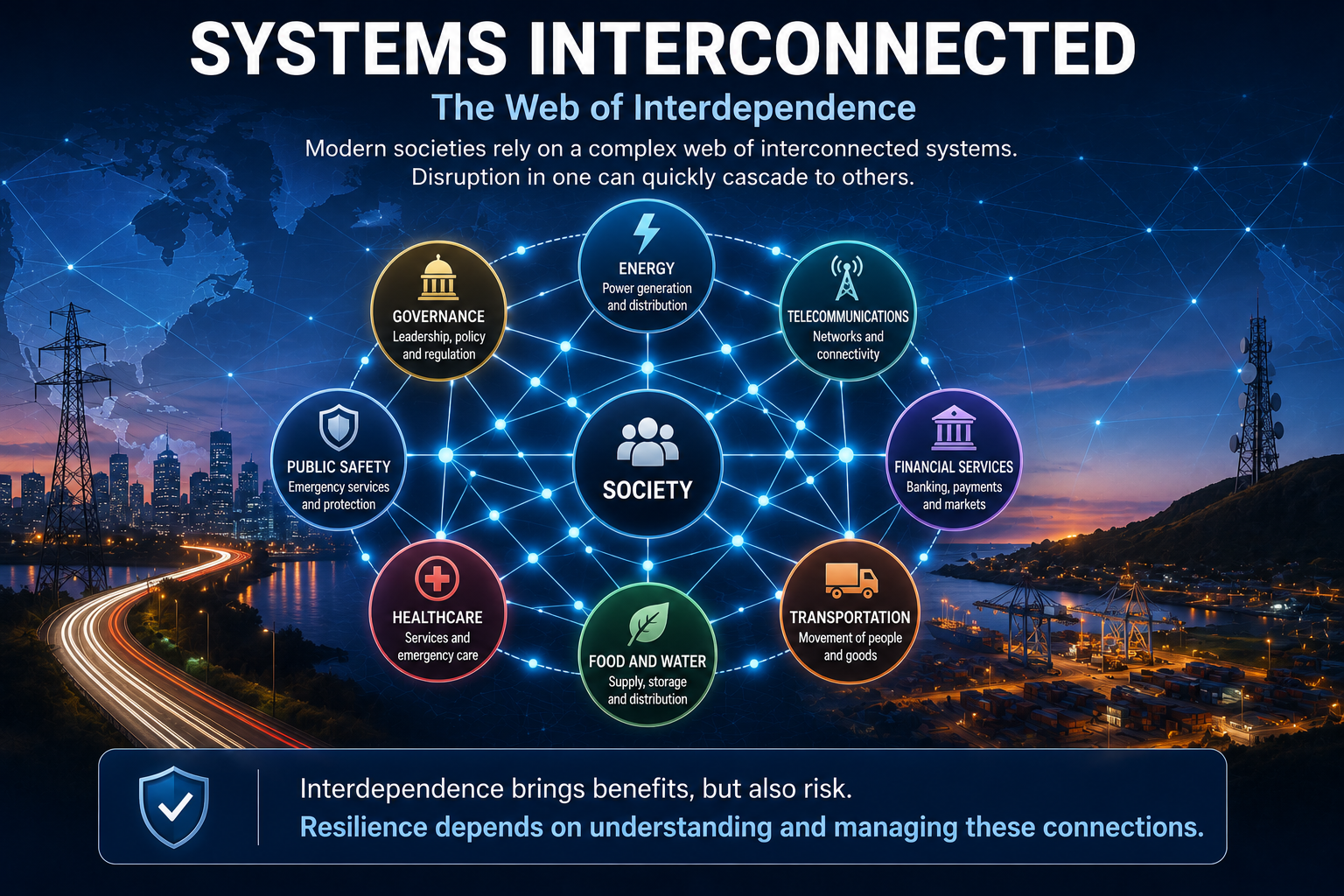
Interconnection brings extraordinary capabilities. It also creates pathways through which disruption can spread. Communications depend on energy; logistics depend on digital services; hospitals and emergency responders depend on both.
Disruption may cross organisational and sector boundaries faster than any single operator can respond. The question is therefore not simply whether one component is secure or reliable. It is whether the essential function can survive the loss of multiple supporting services.
The WCIT paper explores this shift from protecting separate assets to understanding dependencies across systems-of-systems, including how energy can become a foundational constraint on recovery.
Have we optimised away our ability to survive?
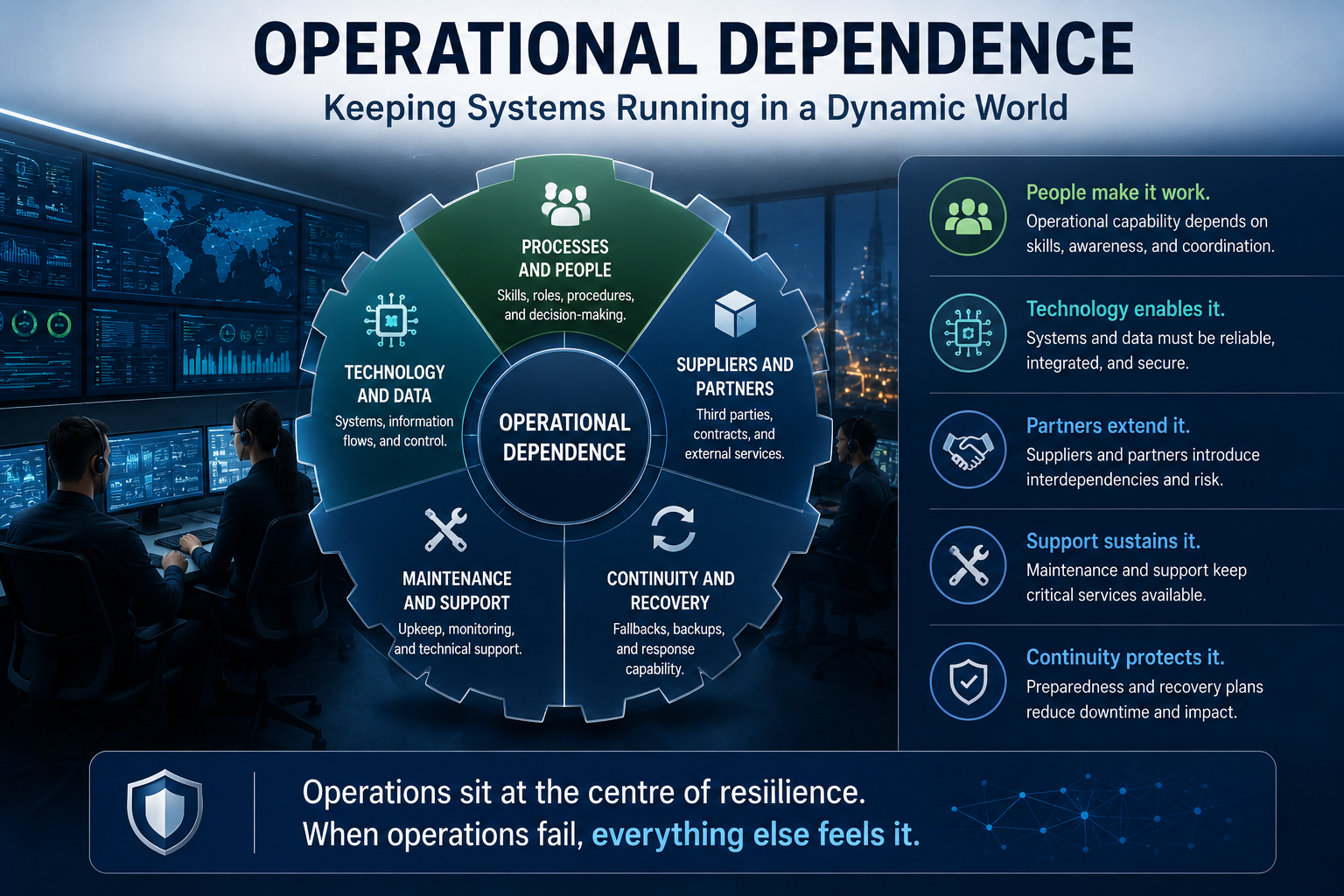
Centralisation, just-in-time supply arrangements and reduced spare capacity can improve efficiency and control costs. They may also remove the alternatives needed when normal operations are no longer possible.
The briefing challenges readers to reconsider those trade-offs. Redundancy, fallback capability, local autonomy and graceful degradation are not necessarily signs of inefficiency; in the right context, they may be prerequisites for maintaining essential functions.
Nor is a technical solution sufficient. Operations depend upon trained people, realistic procedures, maintainable equipment and partners who can continue supporting critical services under pressure.
From protection to survivability
One way to understand the argument is to ask different questions of familiar resilience measures:
| Conventional focus | Survivability question |
|---|---|
| Protecting assets | Which critical functions must continue if the assets are unavailable? |
| Preventing failures | How will services operate safely under degraded conditions? |
| Measuring availability | How quickly can essential capability be restored? |
| Managing separate risks | How might failures cascade between dependent systems? |
Editorial comparison reflecting the themes of the WCIT paper; not a table reproduced from the publication.
Can the essential function remain available, even at reduced capacity?
Can alternative people, pathways or processes take over when normal arrangements fail?
Can critical capability be restored within an acceptable period?
What must survive?
Perhaps the most consequential change is to start not with the question of how to protect a particular system, but with what must remain possible when that system fails. The answer may be a service, mission or societal function, even if it has to be delivered differently.
The full WCIT briefing develops this argument across energy continuity, system architecture, safety and security, the economics of resilience, and the accountability challenges that arise when dependencies cross boundaries. It poses questions for engineers, infrastructure operators, security professionals, leaders and policymakers, rather than claiming that any one architecture or control provides a universal answer.
Explore the complete WCIT briefing paper
How should resilience be understood when interconnected systems are expected to operate despite disruption? Read the complete paper and consider what its questions mean for the functions on which you depend.
Download the full briefing paper (PDF)
Or visit the WCIT Research and Briefing Papers page.
Advertisements

Latest Issue
Student Discount

Briefing Centre

Advertise With DFM